
Britpop, Vol. 3: Manchester, So Much to Answer For...
Unpacking the Smiths' lasting legacy.

Morrissey was born in 1959 and had a flair for drama from the very start. “Naturally, my birth almost kills my mother, for my head is too big,” begins Morrisey’s autobiography, Autobiography. Of all the things I learned while researching the Smiths, I remain fixated on the fact that Morrissey refused to give publishing rights to Penguin unless his autobiography was published under the Penguin Classic imprint. For context, this is an imprint exclusively reserved for books considered literary classics, usually bestowed once the author has died.
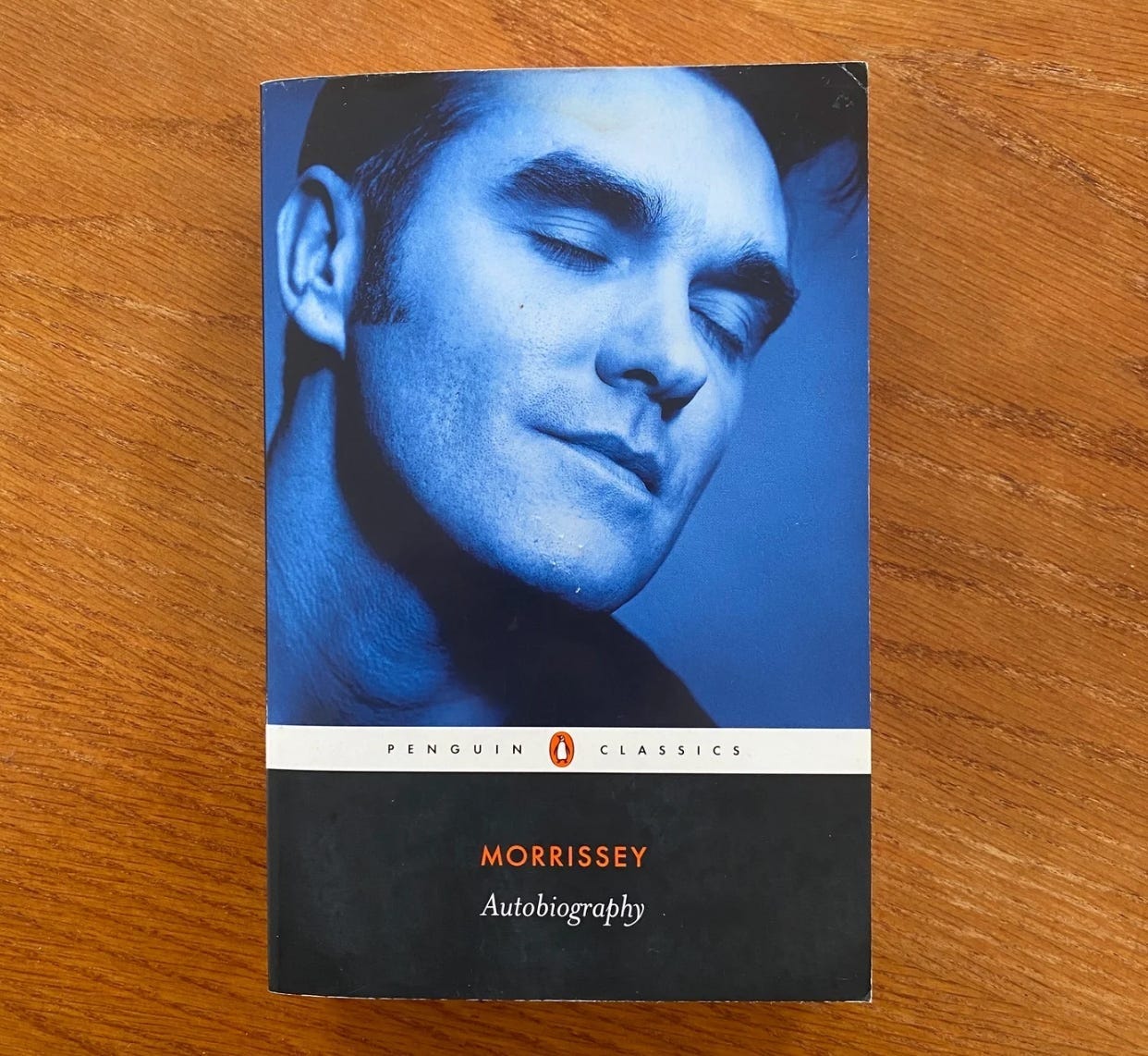
Morrissey endured an unhappy childhood, often feeling ignored and bullied by his classmates. He was close with his mother, but suffered from a general malaise - basically whatever the opposite of a “lust for life” is. While he was growing up, Manchester was plagued by a series of killings referred to as the Moors Murders, in which children and teenagers were lured to the nearby moors, assaulted, and killed. This is the second time in as many newsletters that I’ve mentioned murder, but I promise this isn’t turning into a true crime series…I bring it up because it had a profound effect on the psyche of young Morrissey, leading to the eventual writing of controversial song “Suffer Little Children,” included on the first Smiths album.
The following is an excerpt from Morrissey and Marr: The Severed Alliance:
A relative of the murdered John Kilbride happened to listen to the flip-side of ‘Heaven Knows I’m Miserable Now.’ Kilbride was outraged by the song’s provocative theme and soon made his feelings public. As a result, the Boots and Woolworth’s chains withdrew the offending single from sale, and also banned The Smiths’ debut album.
Morrissey was understandably upset by this, and quickly clarified that the song was written in good faith, and out of a profound sympathy for the children. One positive outcome of the situation was that Morrissey became friends with Ann West - mother to one of the victims - and even included her name in the credits for the second Smiths album.
Although tragic, I find this story to be a good example of how Morrissey’s pompous persona belied a sensitivity and kindness. I recently had the opportunity to speak to photographer Kevin Cummins at an event in Los Angeles, and he said that out of everyone he photographed over his long career, Morrissey was the friendliest. I want to say this up front because I spend a good portion of the remainder of this newsletter making fun of him.
Johnny Marr and Morrissey first met at a Patti Smith concert in 1978, but it wasn’t until 1982 that Marr approached Morrissey, asking him to join his band. Marr was aware of Morrissey’s songwriting ability and he had also been impressed by Morrissey’s fan club for the New York Dolls, which is sort of touching. Morrissey was living alone with his mother, running a fan club for his favorite band out of the basement, and Johnny Marr came along and rescued him from obscurity. Please enjoy this video (below) of Marr and Morrissey being interviewed by a class of children. I especially liked the children’s rendition of “This Charming Man.”
The two young men had instant chemistry as a songwriting duo and in 1983, they released their first single, “Hand in Glove,” as the Smiths. They signed to indie label Rough Trade Records (after being rejected by Tony Wilson’s Factory Records), one of the many British bands making their home on independent labels in the ‘80s.
Morrissey was a consummate showman, and his flamboyance helped the Smiths make their mark amongst other, more mainstream bands. In addition, Marr’s skill as a composer complemented Morrissey’s innate ability to channel his melancholy into his lyrics. His intelligence and delivery made his angst feel poetic, rather than self-pitying (although, sometimes that, too).
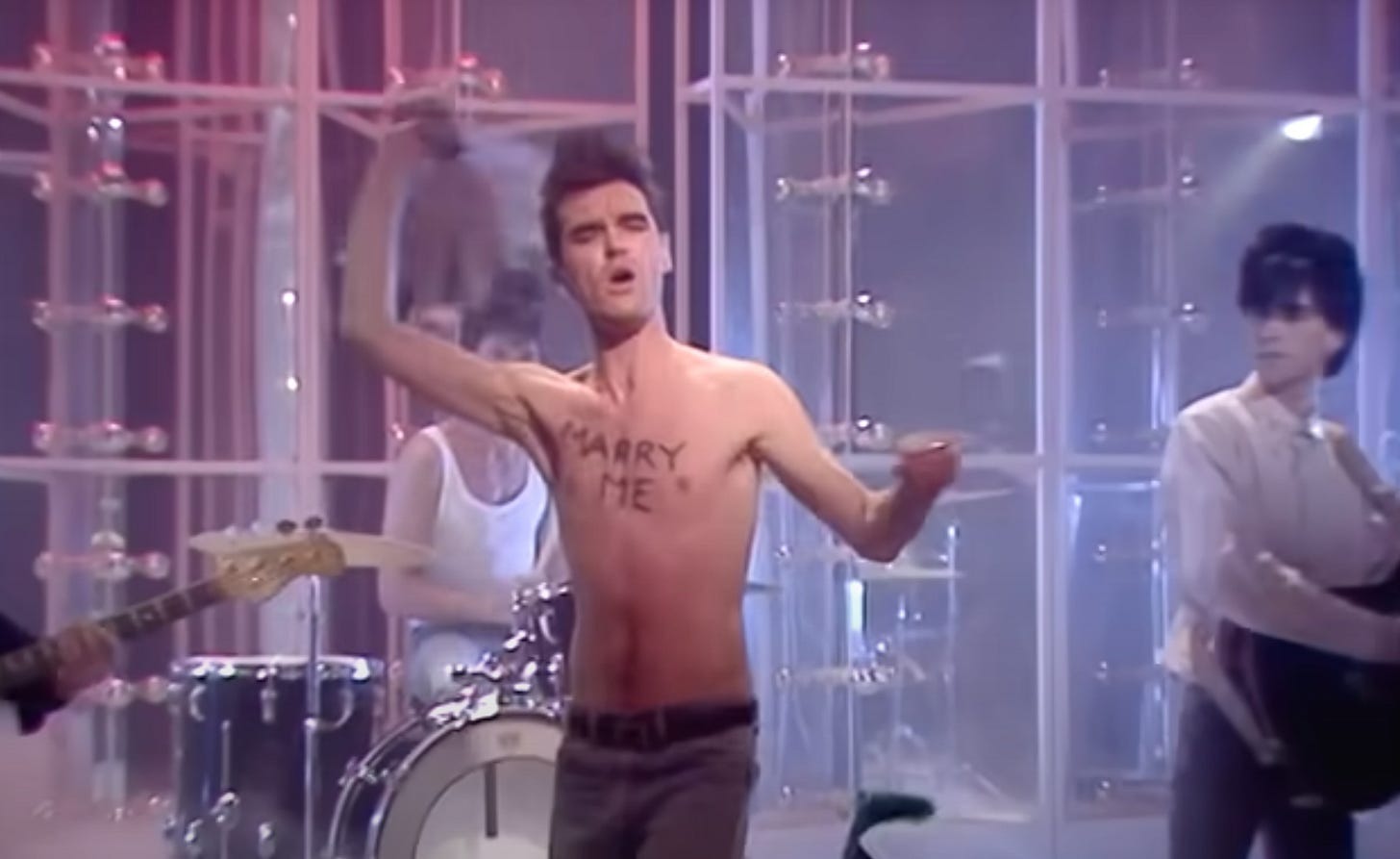
The Smiths became popular quickly after the release of their first single, and recorded their first, self-titled album with producer John Porter. Although successful, Morrissey disliked the production on the album. He viewed it as a disappointment, and to compensate, he insisted the record label release some of their singles and B-sides on a compilation album titled Hatful of Hollow.
At the time, it was common to release singles and albums separately: meaning, popular singles were not usually included on albums because fans had already paid for the physical single. This practice has been a source of consistent confusion for me: more than once, I’ve scoured a band’s entire discography on Spotify looking for a specific song, only to discover it’s not featured on any album. Thankfully, Hatful of Hollow exists, so I can easily find “How Soon is Now?” and “Heaven Knows I’m Miserable Now.”
In 1985, the Smiths released their sophomore album, Meat is Murder, which was entirely self-produced. Morrissey was a staunch vegetarian, and his unwavering moral stance on the issue caused tension in the band. Marr, Andy Rourke (bassist), and Mike Joyce (drums) have stated that eating meat around Morrissey was an uncomfortable experience. By naming the album Meat is Murder, Morrissey made a political statement that wasn’t fully coherent with the identity of the band. This was to be one of many examples of Morrissey exerting creative control over his bandmates - a pattern that would eventually lead to the dissolution of the group.
The Queen is Dead was the third studio album from the Smiths, and by this era, the cracks in Marr and Morrissey’s relationship were beginning to show. Morrissey was becoming increasingly controlling over the band’s direction, refusing to shift or expand upon their style. Meanwhile, Marr was burnt out from having to produce, manage, and write all of the music. Morrissey didn’t want to hire anyone new who would potentially change their dynamic, and some speculate that his desire to keep the band so insular was borne out of an interest in Marr that was more than platonic. It has been theorized that the song “I Won’t Share You” is about Marr (and Morrissey’s solo song “Angel, Angel, We Go Down Together” is confirmed to be about him). Morrissey, for the record, said his feelings for Marr were never romantic: “There was a love and it was mutual and equal, but it wasn’t physical or sexual.”
The boy with the thorn in his side
Behind the hatred there lies
A plundering desire for l-l-love
Morrissey’s victim complex is also on full display throughout the album, starting with his repeat of the line “Life is very long when you’re lonely,” on the outro of the title song “The Queen is Dead,” escalating with “The Boy with the Thorn in His Side,” and culminating in Morrissey comparing his struggles with the media to Joan of Arc burning at the stake. What a ride!
Last year, my dad sent me the song “Death of a Disco Dancer,” which I had never heard before and immediately liked. It sounded sonically different from some of the other, more famous Smiths songs I had heard (it’s also the only time Morrissey plays an instrument on any Smiths song). This led to my exploration of the fourth and final Smiths album, Strangeways, Here We Come, released in 1987. The lead single “Girlfriend in a Coma,” sees the Smiths exploring new territory: Pitchfork journalist Douglas Wolk observed that the Smiths were “desperately trying to not repeat themselves,” and, indeed, Marr is on record stating that repeating himself was like death.
Considered by many critics to be their definitive work, Strangeways also feels like a premonition of the band’s end. Robert Christgau of The Village Voice noted that, “in three of these songs, somebody’s dead or dying, in three more, somebody contemplates murder.” Once again, the Smiths flirted with controversy, referring to “mass murder” on the song “Stop Me if You’ve Heard This One Before,” causing it to be banned in the U.K. and pulled from the album. The song likely drew criticism because it was released in the direct aftermath of the Hungerford massacre, a rare shooting spree in England that resulted in 16 deaths.
And the pain was enough to make
A shy, bald, Buddhist reflect
And plan a mass murder
By the time Strangeways was released, tensions between Marr and Morrissey had reached an all-time high, but ultimately, the Smiths disbanded because of a series of miscommunications. Marr first left the group in July 1987, but according to him, it was just a break. They were on a break! While he was away, the Smiths replaced Marr with another guitarist and attempted to record a few songs. Marr said, “I was really, really hurt. To be replaced so quickly by your friends, before you even had a chance to change your mind? That was the end.” Morrissey reached out after a couple months of radio silence and invited Marr to join him for a Smiths farewell gig, but it was too late. The Smiths were officially broken up. The last song on the Smiths’ last album? The aforementioned “I Won’t Share You.”
Reflecting on the Smiths’ legacy now, it’s clear that they were instrumental in shaping the sensibility of later British pop. Bandsplain’s Yasi Salek believes that The Smiths invented Britpop and I’m inclined to agree. A young Noel Gallagher was hugely impacted by the Smiths’ first televised performance on Top of the Pops, and Graham Coxon of Blur has stated that seeing the Smiths on TV made him realize a band could be “sensitive, witty and distinctly English,” without imitating American rock. Damon Albarn also admired the Smiths’ “Englishness,” especially Morrissey’s unorthodox stage presence.
And so we begin to draw closer to our raison d’etre - we can now clearly trace a line from the spark to the fire (this sounds like something Morrissey would say). We have one more pre-Britpop newsletter before we dive into the real action, and I’m so excited to discuss the rise of Madchester, the Happy Mondays, and the Stone Roses. See you then!
-
With Halloween weekend just around the corner, here are some last minute Smiths-related costume ideas:
Unbutton your shirt down to the waist and hold flowers behind your back to go as Morrissey. And don’t forget the airs of grandeur…
For Johnny Marr, simply take a photo of one of his many questionable haircuts to your barber. Bonus points if you play air guitar.
You could dress as Joan of Arc at the stake, trusty walkman in tow (see: Chloe Sevigny).
Go as the Queen, only dead? This may be too soon.
In the Context
1984:
Michael Jackson is the most famous person on the planet, dominating the Grammys and radio waves with Thriller
The first MTV Video Music Awards show is held, featuring Madonna’s performance of “Like A Virgin”
Bruce Springsteen releases Born in the U.S.A. and Prince releases Purple Rain: two behemoth albums that define the ‘80s
Hip-hop artists like Run-D.M.C. and LL Cool J gain traction and popularity
1985:
Launch of the music channel VH1
The World Live Aid concert for famine relief takes place, with artists like Queen, U2, and David Bowie performing for charity
A group of American artists come together to record the single “We Are the World”
1986:
Pet Shop Boys release their debut album Please, which includes hit “West End Girls”
Artists like Peter Gabriel, Lionel Richie, and Whitney Houston dominate the charts
Rock and Roll Hall of fame holds first induction ceremony, honoring legends Elvis Presley, Chuck Berry, and James Brown
Media Consumed:
The Smiths: Under Review (2006)
Bandsplain podcast - The Smiths part 1
Bandsplain podcast - The Smiths part 2
I did not read Autobiography by Morrissey. There are no chapters! It’s just one giant wall of text. Impossible.
Thanks for stopping by,
x Kelsey